Work has limited my spare time to paint up miniatures but I have just allowed myself a spell to re-vamp some of the white-coated figures restored to my collection. I'm pleased to report that three battalions are now pretty well ready for the wargames table, only awaiting to be issued their regimental colours. I've decided to paint up the 1792 pre-amalgam style flags despite the likelihood of them forming a centre battalion for Line demi-brigades. These figures can be utilised to provide French regulars for several earlier conflicts (for wargame purposes) so I will keep the white cross of Saint Denis with distinctive cantons which was so much a feature of French military flags in the 18th century.
Two more 'blanc' battalions still to complete, and my box of spares may well provide two more 'bleu' battalions. MGB
Wargame Rules, Ratios, etc
RAISING MINIATURE ARMIES FOR THE LATE 18TH CENTURY
I am very keen to keep my wargame rules as simple as possible, yet capture the character of the 1790s. Morale dominates the games as the opposing sides are very different. Most of the French troops are 'levee' battalions, which I have chosen to base in column as their ability to change formation on a battlefield must have been limited, nor do I believe their volley fire had any great value. Of better quality, able to change formation, will be white-coated regular and blue-coated volunteer battalions, aided by a fair number of skirmishers. The British, Austrian, Dutch and German armies are often outnumbered, but they maintain the discipline and order of typical 18th century armed forces. Interestingly, French revolutionary cavalry have little in common with their later Napoleonic counterparts, the former are few in number, often poorly mounted, and no match for those in the service of the Allies. All figures are 28mm in scale, using a 1=25 ratio.
Followers
Saturday, 4 July 2015
Saturday, 6 June 2015
French Regulars, more white-coated infantry for the 1780-90s
In the early 1990s I raised a fairly large collection of Wargames Foundry figures for the French Revolution, only to then sell them on. Last week I made contact with my old friend, John Tuckey, who regularly wargamed with me during the 1980s. He had purchased these figures from me, but with his interests having returned to model railways, he kindly offered to let me buy them back at about the same price I sold them, 65p each. Well I couldn't allow this generosity to pass, it has been my intention to increase the new collection by raising more battalions in white uniforms. With the exception of an improved way I paint faces and hands, the figures only need rebasing. I'm very pleased with these additions, restored to my collection. Here's a photo of the figures awaiting orders to be formed into their respective battalions. I should add, I also picked up a unit of Garrison Miniatures dragoons, previously mine, and I will write more about these on a future post. MGB
Friday, 29 May 2015
Light Troops in Action Wargame c.1793
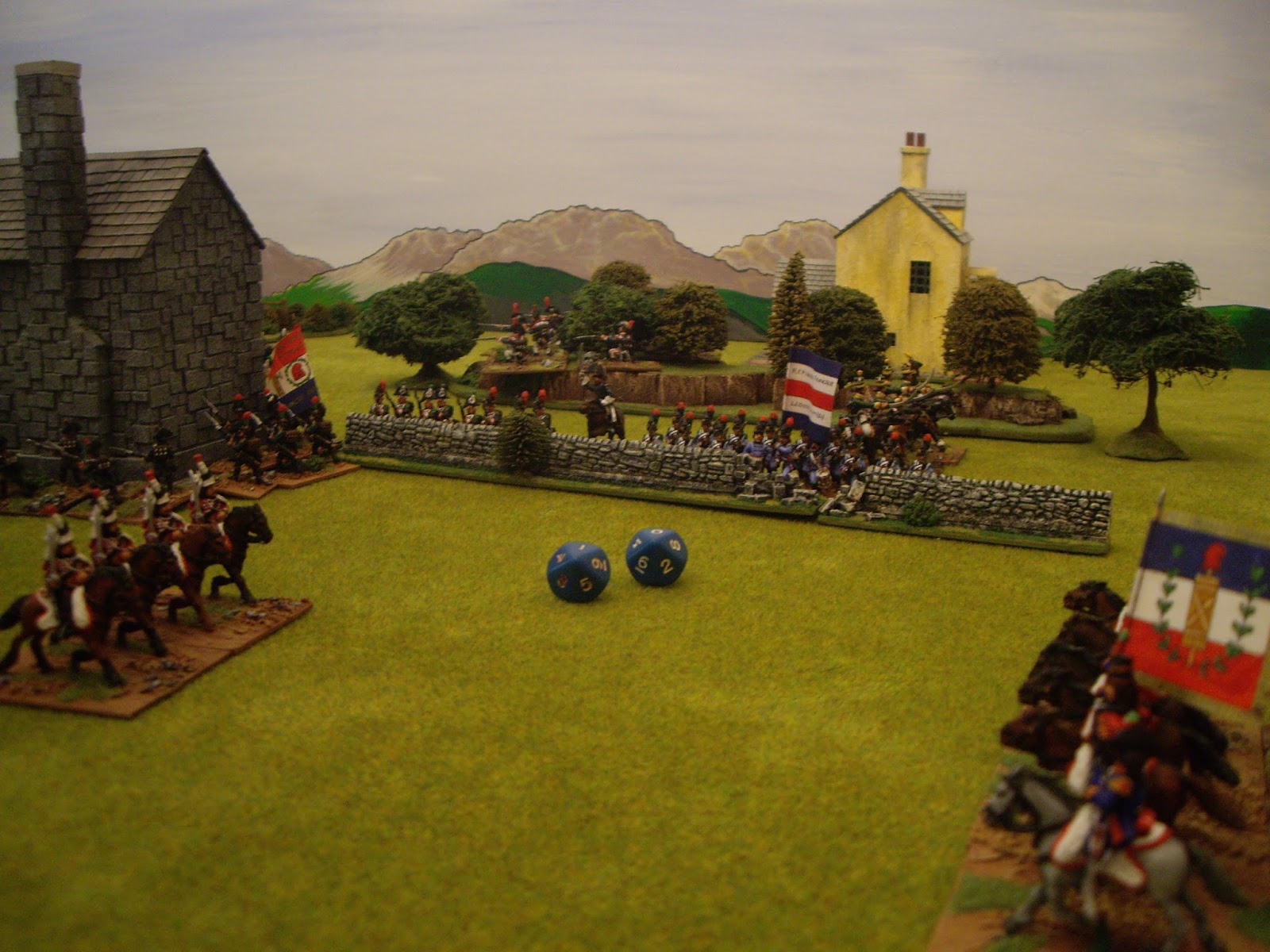
Some friends and I decided to have a late evening wargame. Starting at 9pm we ceased at 11.30, recommenced at 10.30am and concluded one hour later. This was a fun action and all agreed the scenario and rules were exciting and realistic.
The game was based on the idea that both sides had sent out a motley force of light troops as an advanced guard, and to also secure a useful bridge, warehouse, and watermill. The British and Allies were commanded by George Mills, and comprised the following:
Mtd. Commander
9th Light Dragoons, 6 figs. (b)
York Hussars, 6 figs. (b)
Salm Hussars, 6 figs. (b)
Salm Infantry, 18 figs. (b)
Salm Light Horse Artllery with limber, 3 figs. (b)
Luninck Light Infantry 12 figs. (b) skirmishing
Riflemen from Beon and Damas Legions, 8 figs. (b) skirmishing
Lowenstein Chasseurs armed with rifles, 12 figs. (b) skirmishing
The French were under the control of Chris Smith, and comprised the following:
Mtd. Commander
3rd Hussars, 6 figs. (c)
4th Hussars, 6 figs. (c)
4th Chasseurs a Cheval, 6 figs (c)
7th Chasseurs a Cheval, 6 figs (c)
Detached grenadiers, 10 figs. (b) skirmishing
Legion des Allobroges light infantry, 16 figs. (c) skirmishing
Legion du Midi light infantry, 16 figs. (c)
Paris Chasseurs, 8 figs. (c) skirmishing
Two companies of Paris National Guard. 8 figs. (c) skirmishing
Some key features of the game included the French throwing twentyfour marksmen into the warehouse, while the grenadiers were posted to a wooded hill, both becoming strongpoints for which the allies were unable to silence. The York Hussars were surprised by French cavalry while crossing the bridge and forced to retire, some chasseurs were met by heavy musketry when they attempted a similar move. On the French left there was a series of cavalry charges and melees which finally ended in the Allies driving the French horse off the field, but with their own cavalry in no fit state to engage any further enemy it was agreed the French had won the action. We all enjoyed this small battle and it was interesting to utilise so many skirmishing units. While the allied riflemen inflicted some casualties, the careful use of cover by the French player reduced their effectiveness. Here is a few photos from the action. MGB
LOSSES: British & Allies 22 k,w,missing. French Republican 31 k,w, missing
The game was based on the idea that both sides had sent out a motley force of light troops as an advanced guard, and to also secure a useful bridge, warehouse, and watermill. The British and Allies were commanded by George Mills, and comprised the following:
Mtd. Commander
9th Light Dragoons, 6 figs. (b)
York Hussars, 6 figs. (b)
Salm Hussars, 6 figs. (b)
Salm Infantry, 18 figs. (b)
Salm Light Horse Artllery with limber, 3 figs. (b)
Luninck Light Infantry 12 figs. (b) skirmishing
Riflemen from Beon and Damas Legions, 8 figs. (b) skirmishing
Lowenstein Chasseurs armed with rifles, 12 figs. (b) skirmishing
The French were under the control of Chris Smith, and comprised the following:
Mtd. Commander
3rd Hussars, 6 figs. (c)
4th Hussars, 6 figs. (c)
4th Chasseurs a Cheval, 6 figs (c)
7th Chasseurs a Cheval, 6 figs (c)
Detached grenadiers, 10 figs. (b) skirmishing
Legion des Allobroges light infantry, 16 figs. (c) skirmishing
Legion du Midi light infantry, 16 figs. (c)
Paris Chasseurs, 8 figs. (c) skirmishing
Two companies of Paris National Guard. 8 figs. (c) skirmishing
Some key features of the game included the French throwing twentyfour marksmen into the warehouse, while the grenadiers were posted to a wooded hill, both becoming strongpoints for which the allies were unable to silence. The York Hussars were surprised by French cavalry while crossing the bridge and forced to retire, some chasseurs were met by heavy musketry when they attempted a similar move. On the French left there was a series of cavalry charges and melees which finally ended in the Allies driving the French horse off the field, but with their own cavalry in no fit state to engage any further enemy it was agreed the French had won the action. We all enjoyed this small battle and it was interesting to utilise so many skirmishing units. While the allied riflemen inflicted some casualties, the careful use of cover by the French player reduced their effectiveness. Here is a few photos from the action. MGB
LOSSES: British & Allies 22 k,w,missing. French Republican 31 k,w, missing
Monday, 6 April 2015
Legion des Allobroges, 1792
My number of light troops continues to increase with sixteen green coated skirmishers belonging to the Allobroges Legion. This unit is known to have changed its uniform on several occasions, brown and also blue in later years. I have decided to stick with their original colour. Its establishment was set at fourteen companies of light infantry, formed into two battalions, three companies of light? dragoons, a company of artillery, and a section of foot gendarmes. Raised at Grenoble in August 1792 from Alpine folk, the recruits actually came from the Alpes, the South of France, Toulon, and possibly also the Pyrenees. The corps formed part of the Army of the Alpes. In later years the legion was broken up with the foot joining the 4th Light Demi-Brigade, the cavalry serving in the 15th Dragoons. I couldn't find anything on their flag, except a claim that they had raised the tricolour on Mont-Blanc, which I assume is propaganda. So I have used a flag which appears on a engraving of the battle of Montenesimo, 1797. With their almost entirely green uniform they may look a little drab, but the French player will no doubt find them useful. MGB
Thursday, 2 April 2015
The Kingdom of Wittenberg Blog (Fiction)
This is a departure from my usual entries but I would like to promote it here. The Kingdom of Wittenberg is a blog about a fictitious 18th century state. Inspired by the Grant and Asquith wargame books of the 1970s, the figures are 25-40mm miniatures engaging in diplomacy, warfare and cultural aspects of the Georgian age. If you too like the period, need to be inspired to paint up those lead figures, and want some entertaining reading, visit this blog. If I may, make a point to start with the very beginning and work your way to the latest entry. An occasional smile is guaranteed! MGB
tidders-kingdomofwittenberg.blogspot.co.uk
Sunday, 8 March 2015
Privateers in the French Revolutionary Wars
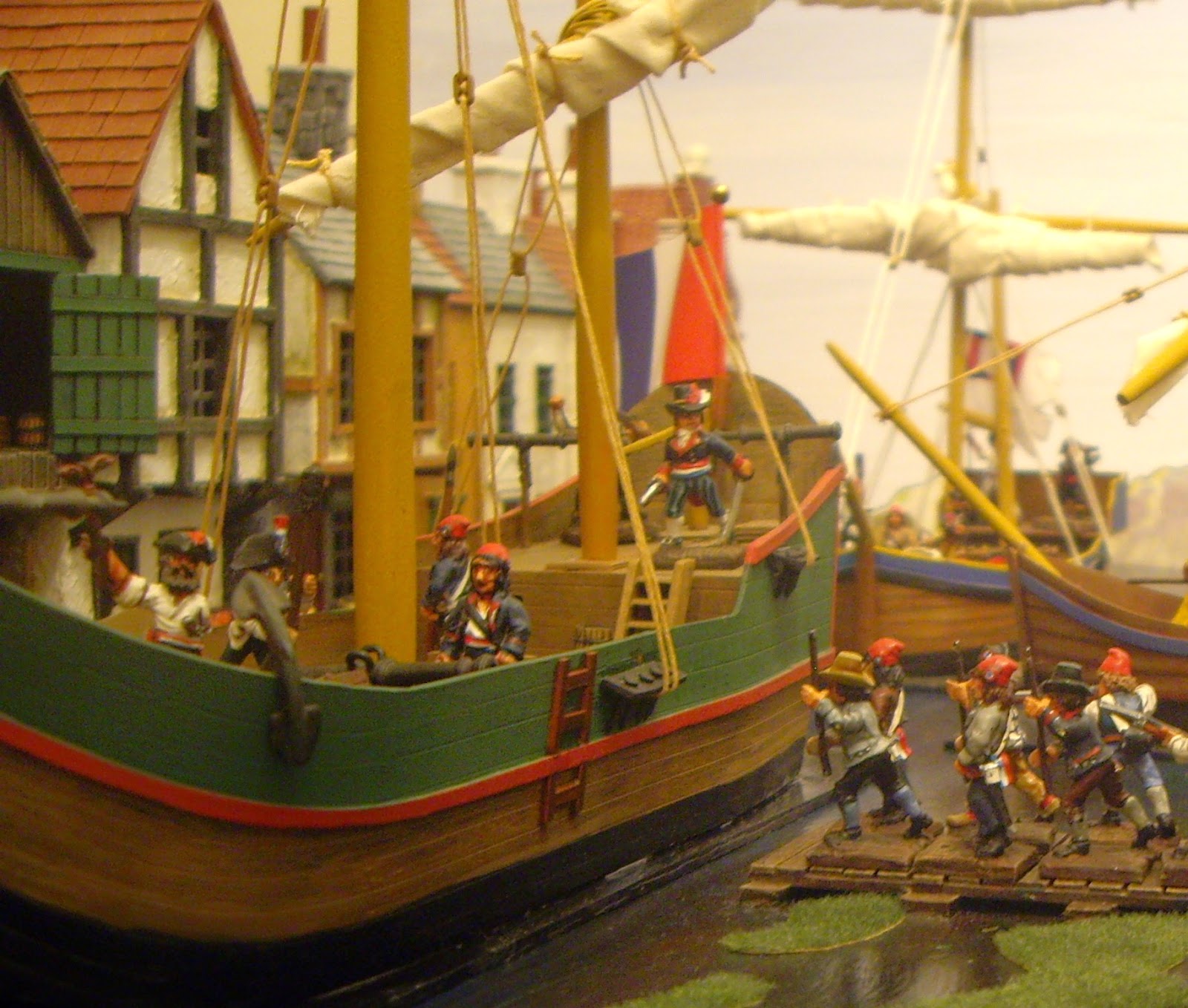
With the outbreak of war between the French Republic and Great Britain in 1793 large numbers of privateers were kitted out on both sides of the English Channel. The City of St.Malo was the operational base of a fair number of privateers, or 'corsairs', the most successful being Robert Surcouf. This corsair even preyed on British shipping in the Indian Ocean. Although St.Malo is in Brittany it appears the local population had a strong, independent spirit. They had little attachment to the Bretton peasantry, who where strongly Catholic and sympathetic to a Royal restoration. It appears the residents of St.Malo had only a slight regard for the French Government, as the authorities were hostile to privateering, wanting all who were able to join the French Navy.
My small fleet of privateers are scratch built of plastic card. Worn-out paintbrushes, wood glued into blocks of wood, serving as masts. They are quite robust for game purposes.
With Royal Navy vessels in the making, and a landing party that is already painted and ready, I am looking forward to some interesting scenarios. MGB
My small fleet of privateers are scratch built of plastic card. Worn-out paintbrushes, wood glued into blocks of wood, serving as masts. They are quite robust for game purposes.
With Royal Navy vessels in the making, and a landing party that is already painted and ready, I am looking forward to some interesting scenarios. MGB
French Privateers, the Corsairs of St.Malo Flag
As I'm about to upload some photos of my St.Malo Corsairs I thought the following might be of interest. It is thought to be the flag which was utilised by these privateers. The canton creature is a stoat, no doubt connected to the ermine which traditionally formed part of the heraldry of Brittany. MGB
Subscribe to:
Posts (Atom)